
Relax. I’m a Cybersecurity Pro, and Mythos Scares Me Too.
Anthropic’s Claude Mythos Preview demonstrates how advanced AI can accelerate vulnerability discovery, exploit development, and other cybersecurity tasks. For credit unions, the most important implication is a compressed attack timeline, not an entirely new intrusion process. AI-enabled attackers still move through recognizable stages of the Cyber Kill Chain. By identifying external exposures, strengthening detection, and disrupting any stage before attackers reach their objectives, financial institutions can manage cyber risk without pursuing the impossible goal of eliminating it entirely.
By Joshua Gideon, Director of Cybersecurity Management, Allied Solutions
Key Takeaways
- AI’s most immediate cybersecurity impact is a faster attack clock. Credit unions must reduce the time required to identify exposures, detect malicious activity, and interrupt intrusions before attackers can reach their objectives.
- The Cyber Kill Chain remains a practical defensive framework because AI-enabled attacks still move through recognizable stages. Breaking any one stage can prevent an attacker from completing the intrusion and causing harm.
- Zero risk is not a realistic cybersecurity objective. Financial institutions should focus instead on resilience, early exposure reduction, and faster detection and response, especially as AI increases attackers’ efficiency and scale.
Do articles about Anthropic’s Mythos keep appearing in your LinkedIn feed and leave you wondering what comes next?
I work in cybersecurity, and I’ll admit it: Even I feel a small knot in my stomach when the latest AI headlines appear.
But Mythos is more than clickbait. It has prompted people to ask me and my colleagues the same question:
“Should we be worried about Mythos?”
The short answer is no, but perhaps not for the reason you think.
There is something real to pay attention to. It just is not the part keeping most people up at night.
Are We Afraid of Mythos for the Wrong Reason?
In a recent Allied Solutions survey, credit union respondents rated their preparedness for emerging information security threats associated with Anthropic’s Claude Mythos Preview at an average of 4 out of 10.
That concern is understandable. A model that can reason, write code, and execute tasks at remarkable speed deserves our attention.
But the real challenge is not Mythos itself, the next AI model, or the one after that.
Beneath the concern about Mythos is the fear that a new capability is challenging both how we defend and what we protect.
What is unsettling is the realization that AI is accelerating the pace of cyberattacks, causing many organizations to question whether the security strategies they have relied on for years are still enough.
The good news? The fundamentals have not changed.
The ways attackers compromise organizations remain remarkably consistent. What has changed is how quickly, broadly, and efficiently those steps can unfold.
The Cyber Kill Chain
Picture what might happen when threat actors use Mythos against a financial institution. Maybe you imagine an invisible force, a digital genius moving in ways no human could, slipping through defenses and taking whatever it wants.
Now replace that image with a clearer picture of what Mythos is and how threat actors could use it.
In 2011, Lockheed Martin introduced the Cyber Kill Chain, a framework that explains how a cyber intrusion unfolds. The concept comes from the military idea that an attack requires a sequence of steps to reach its target. Break any one of those steps, and the attack falls apart.
The framework has seven stages, which can be grouped into four broader categories:
- Reconnaissance: The attacker maps assets, gathers intelligence, and identifies vulnerabilities.
- Weaponization, Delivery, and Exploitation: The attacker prepares a way in, delivers the chosen weapon, and exploits a weakness.
- Installation and Command and Control: The attacker gains access and attempts to maintain it, establishing a foothold on a machine or account, creating persistence, and opening a communications channel.
- Actions on Objectives: The attacker moves toward the intended outcome, whether that means stealing a database, initiating a fraudulent wire transfer, or locking drives behind a ransom demand.
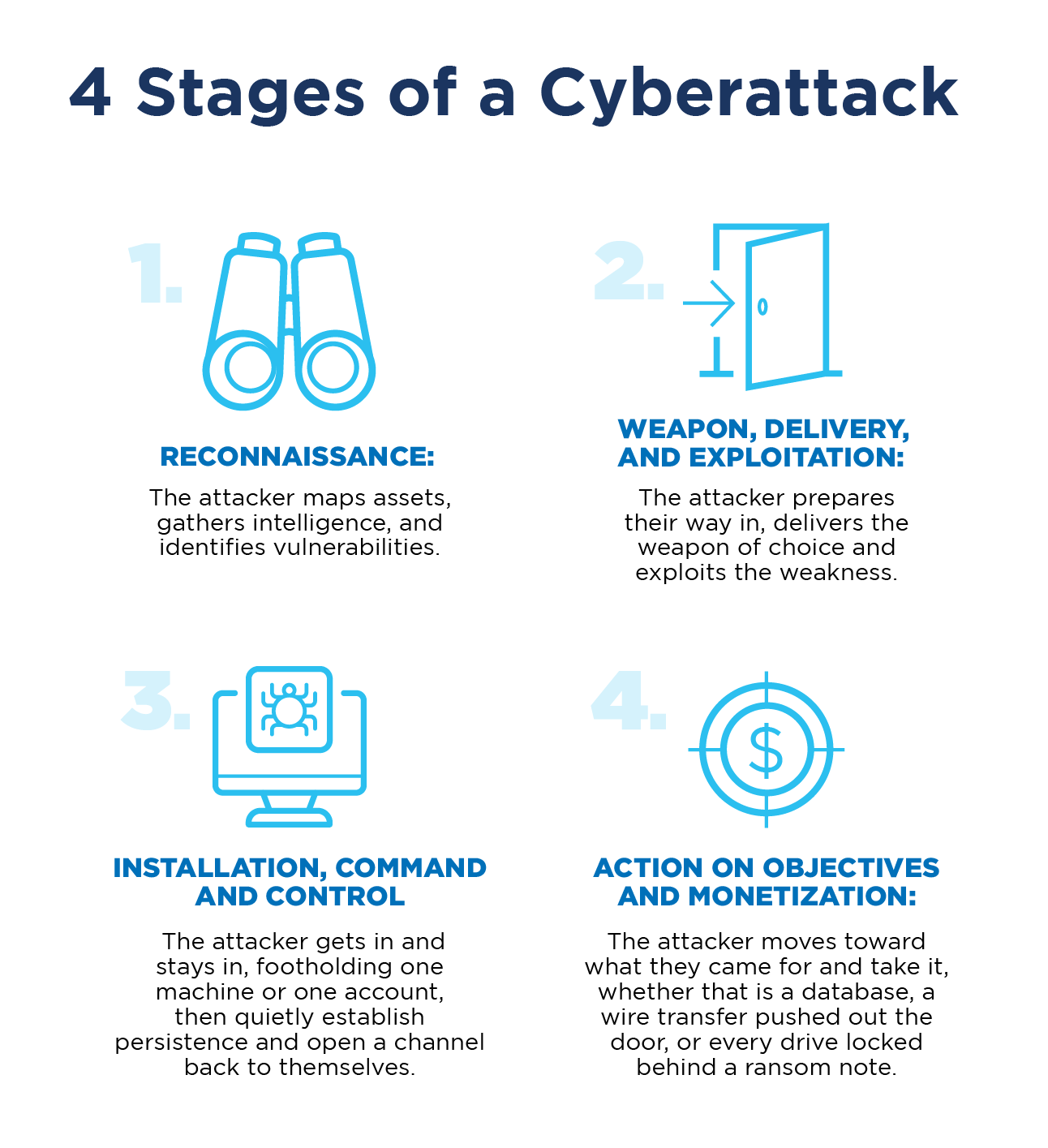
Notice that Mythos did not create a new stage. The chain followed by an AI-enabled attacker is the same chain followed by a human attacker, stage for stage.
Reconnaissance is reconnaissance.
A foothold is a foothold.
The most useful question is not simply, “What new thing can Mythos do?”
The question is, “What does Mythos change about the things attackers already do?”
The most immediate answer is time.
The same chain now operates on a faster clock.
If the Clock Got Faster, Who Is Holding the Stopwatch?
The people who turn a model like Mythos into a threat against a credit union are not necessarily bored teenagers wearing hoodies in dark rooms, suddenly able to rob a financial institution because a chatbot did their homework.
Today’s cybercriminals include organized groups that were dangerous long before Mythos entered the picture.
A real intrusion against a financial institution has rarely been a one-person job, and it still is not. One person finds a way in, another builds or supplies the tools, someone else moves the money, and another negotiates the ransom.
The criminal economy, often structured around Ransomware-as-a-Service, operates like a business with specialists, affiliates, and recurring revenue.
The overall attack has not become simple, and AI does not eliminate the need for expertise. It can, however, automate parts of the process and help attackers complete difficult tasks faster.
When the clock collapses from days to hours, the old comfort of believing a financial institution is too small or too uninteresting to target begins to disappear.
Attacking more organizations can now cost criminals less time and effort.
Here is the uncomfortable reality: If your security practices were weak, they were always weak.
You may not have been protected.
You may simply have gone unobserved.
Many organizations are about to discover which one they were.
AI Changed the Tools. It Did Not Change the Criminals.
The cybercriminal organization behind Ransomware-as-a-Service is worth understanding because it shows where AI fits.
In a Ransomware-as-a-Service model, the platform supplies the ransomware capability. An affiliate obtains access to the tools, directs them at a target, and shares a portion of the proceeds with the platform operator. AI can then accelerate or automate parts of that affiliate’s workflow.
It is true that AI can make an affiliate’s job easier, but the organized operation behind the affiliate remains a critical part of the threat.
This changes how credit unions should think about defense. Guessing whether an attacker is a genius or a novice is meaningless because, in a rented-platform model, even a novice may have access to professional-grade tools.
You defend against the capability coming at you, not the résumé of whoever happens to be using it.
But what if we were never meant to achieve zero risk?
Anyone who promises zero risk is selling a feeling, not a fact.
What if Zero Risk Isn’t the Goal?
AI does not fundamentally change the attacker’s objective. It changes the tools, scale, and speed of the attack.
In practice, credit unions can use the Cyber Kill Chain because every stage of an intrusion represents an opportunity to stop it.
Here is the point I most want you to remember:
You cannot, and never will, reduce risk to zero.
Neither before Mythos nor after it.
Neither with an unlimited budget nor with the best team.
Think about the implications. If zero risk was never the goal, then falling short of zero was never the failure.
Reconnaissance is the one stage that occurs before an attacker has entered your environment. By seeing your institution the way an attacker sees it and closing the exposures that person or system might find, you can prevent much of the fast, tireless work downstream from ever beginning.
You will not win a speed race against a machine. The better strategy is to avoid racing it at all. Get there first by identifying and addressing exposures before attackers begin looking for them.
The chain does not care where you break it. Against a threat whose greatest advantages include speed and scale, however, acting before an intrusion begins can deliver significant defensive value.
Do This the Next Time Mythos Puts a Knot in Your Stomach
When the next Mythos article lands in your inbox and puts a fresh knot in your stomach, do this:
Read it. Take it seriously. Then picture the chain and ask the question that has always mattered:
“Where can we break the chain sooner?”
The AI tool generating concern may keep changing, but that question remains the same.
