
How Can Credit Unions Detect Lending Risk Earlier?
This article explains how credit unions can detect lending risk before a borrower's first missed payment. Drawing on insights from Anne Holtzman, Senior Vice President of Risk Management Services, and data from tracking more than 23 million auto loans, it identifies insurance coverage changes as an early warning signal of loan distress. The piece outlines a three-stage deterioration pattern, beginning with an increased insurance deductible, followed by a coverage lapse or cancellation, and ending with a missed loan payment, noting that repossession conversations typically begin about 90 days after an insurance lapse.
Key Takeaways
- Insurance coverage changes signal loan distress before the first missed payment, giving credit unions an earlier window to intervene. Because repossession conversations typically begin 90 days after a coverage lapse, monitoring insurance status enables proactive servicing that traditional delinquency tracking misses.
- Repossession has become a financial decision rather than a last resort, as affordability pressures drive rising voluntary surrenders. This matters because the average $11,000 deficiency balance is recovered only 3% of the time, making early detection far more valuable than post-repossession recovery.
- Effective lending risk management combines AI-driven analytics with human judgment, not one or the other. AI surfaces risk patterns earlier, but people convert those patterns into strategy through partnerships and borrower engagement, protecting both portfolios and members.
Risk is quietly compounding across lending portfolios, and the pace is accelerating, catching many credit unions off guard.
Higher-dollar loans driven by the rising cost of vehicles and homes. More unsecured volume. Digital lending opening doors for fraud.
All of these risks are stacking up, and so are the losses.
The First Missed Payment Isn't the First Warning Sign
Recently on the Allied Angle, Anne Holtzman, Senior Vice President of Risk Management Services, shared how insurance coverage serves as an early indicator of future delinquencies:
"In nearly forty years in the industry, I've never seen the year-over-year premium increases like we're seeing today. Twenty percent of all drivers are uninsured. At any time, 50% of policies are shopping for a lower rate, higher deductible, or less coverage. There is a 15 to 24% increase in insurance premiums. All of that is leading to an affordability issue. What will happen is that borrowers will increasingly raise their deductibles, and that is the first sign of a missed payment."
Record year-over-year insurance premiums are putting unprecedented financial strain on borrowers. From tracking over 23 million auto loans, we see a clear trend emerge: lapsed insurance coverage precedes recovery activity. On average, repossession conversations begin about 90 days after an insurance coverage lapse.
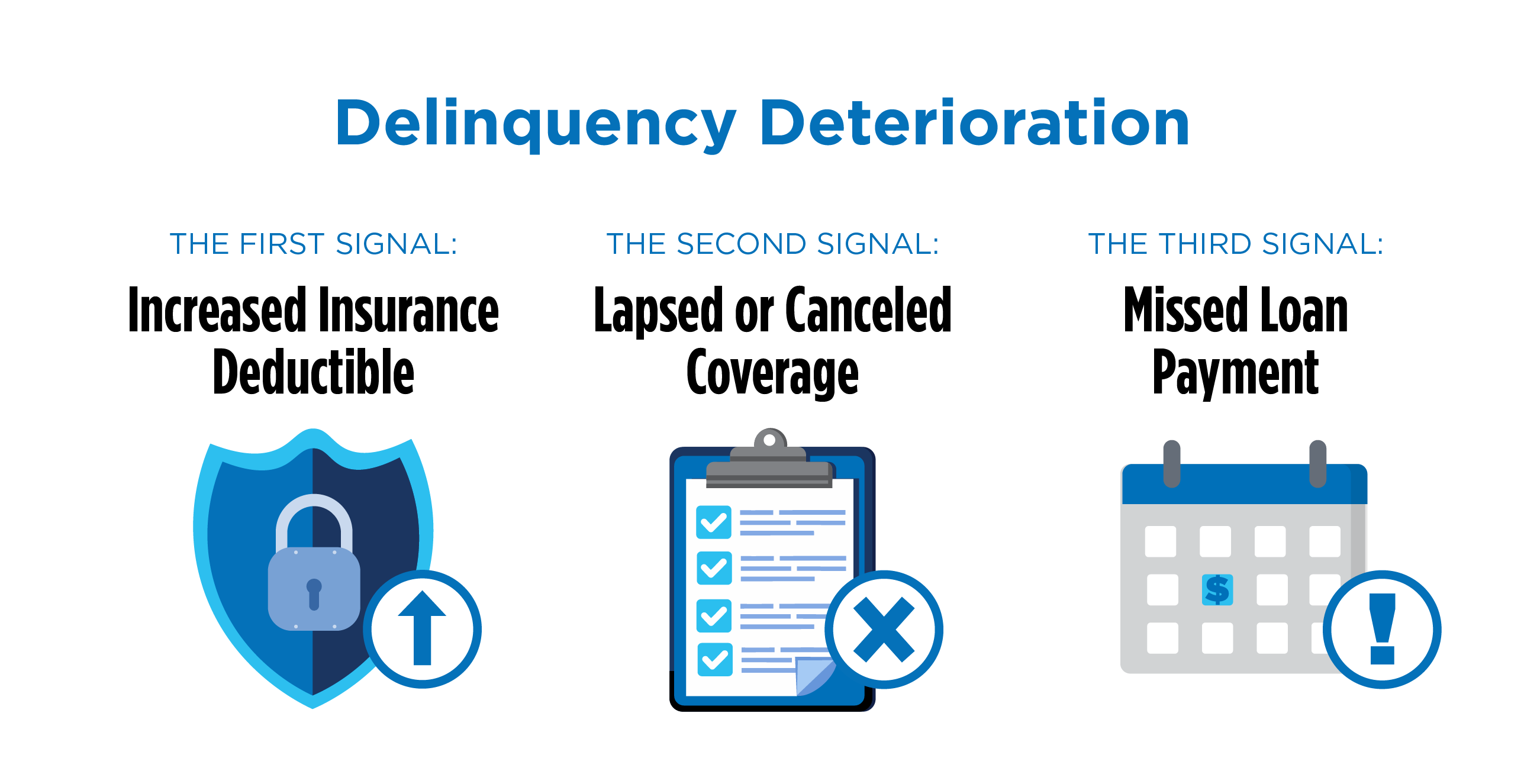
Delinquency Deterioration
The first signal: an increased insurance deductible. The second signal: a lapse or cancellation of coverage. The third signal: a missed loan payment.
By the time the first missed payment occurs, many loans have already progressed too far for early intervention.
Are We Asking the Wrong Questions to Gauge Risk?
For years, the defining question was simple: "Did the borrower pay?"
Today, a more proactive question matters: "How can we engage the borrower before the first missed payment?"
In today's economy, voluntary surrender rates are rising, shrinking the window credit unions have to intervene before recovery begins.
The vehicle affordability crisis has overshadowed the stigma of repossession. The mismatch between the loan and the vehicle's value is prompting many drivers to hand back the keys rather than deal with an upside-down loan.
The average deficiency balance is $11,000, and only 3% of lenders are ever able to collect on those balances.
This is where the risk doesn't just add up. It multiplies.
Is Digital Lending Fueling the Fraud Battle?
Fraud in lending has crescendoed in recent years. It is no longer confined to origination but has become a thread woven throughout the life of the loan, even though many of its root causes still begin at the origination stage.
Part of the increase in fraud stems from the patchwork nature of lien perfection across states. On the Allied Angle, Anne noted that when states respond differently to title washing, these state-level inconsistencies quickly become an industry-wide challenge.
This is an opportunity for credit unions and dealers to work together to reduce fraud at origination. Perfecting liens and collecting complete borrower information, including insurance and employment details, are key tactics for reducing fraud while preserving the convenience of digital lending.
Risk management in the digital era isn't becoming less human, it's becoming more informed. The institutions that manage risk holistically are using AI to identify risk earlier.
Anne shared a unique perspective on AI in lending on the Allied Angle:
"AI can help you identify proactively where risk might be, but it's still a human interaction. The entire process, it's still a human aspect. AI isn't going to help you choose the right partners. You need to have a human voice and process that allows you to turn the analytics into strategy."
AI can surface patterns, but people turn those patterns into action. As lending risk continues to evolve, credit unions that combine predictive analytics with proactive servicing, strong partnerships, and timely borrower engagement will be best positioned to protect both their portfolios and their members.
