
Gaining a Competitive Advantage in Auto Lending
Auto lending growth increasingly depends on what happens after origination. Credit unions can strengthen portfolio performance by managing the full loan lifecycle, including servicing, protection products, GAP, total loss, recovery, vendor performance, and member communication. Effective asset risk management helps lenders identify problems earlier, act faster on deteriorating assets, reduce potential loss severity, and protect the member relationship. In 2026 and beyond, continuous lifecycle management is becoming a more important source of competitive advantage.
Key Takeaways
- Lifecycle servicing is becoming a primary competitive advantage in auto lending because it influences member satisfaction, operational efficiency, recovery outcomes, and long-term portfolio performance after the one-time origination event.
- Recovery velocity can materially affect both loss severity and the member relationship, making early problem identification, timely communication, and coordinated action essential when an auto asset begins to deteriorate.
- Credit unions can strengthen lifecycle value by connecting servicing, protection products, GAP, total loss, vendor management, recovery strategy, and member communication instead of managing these functions in isolation.
In recent years, credit unions have focused on optimizing the front end of the business: origination volume, pricing, credit boxes, advance rates, and approval strategies.
And they should. That work matters.
But the center of gravity has shifted.
Shifting Gears: What Is Really Driving Loan Growth in 2026?
For years, lenders could remain competitive by building a stronger origination engine. Today, that strategy is changing. Most lenders can buy volume, price to a model, and implement creative underwriting strategies. Origination is still a single event, but servicing is no longer a one-time operational function.
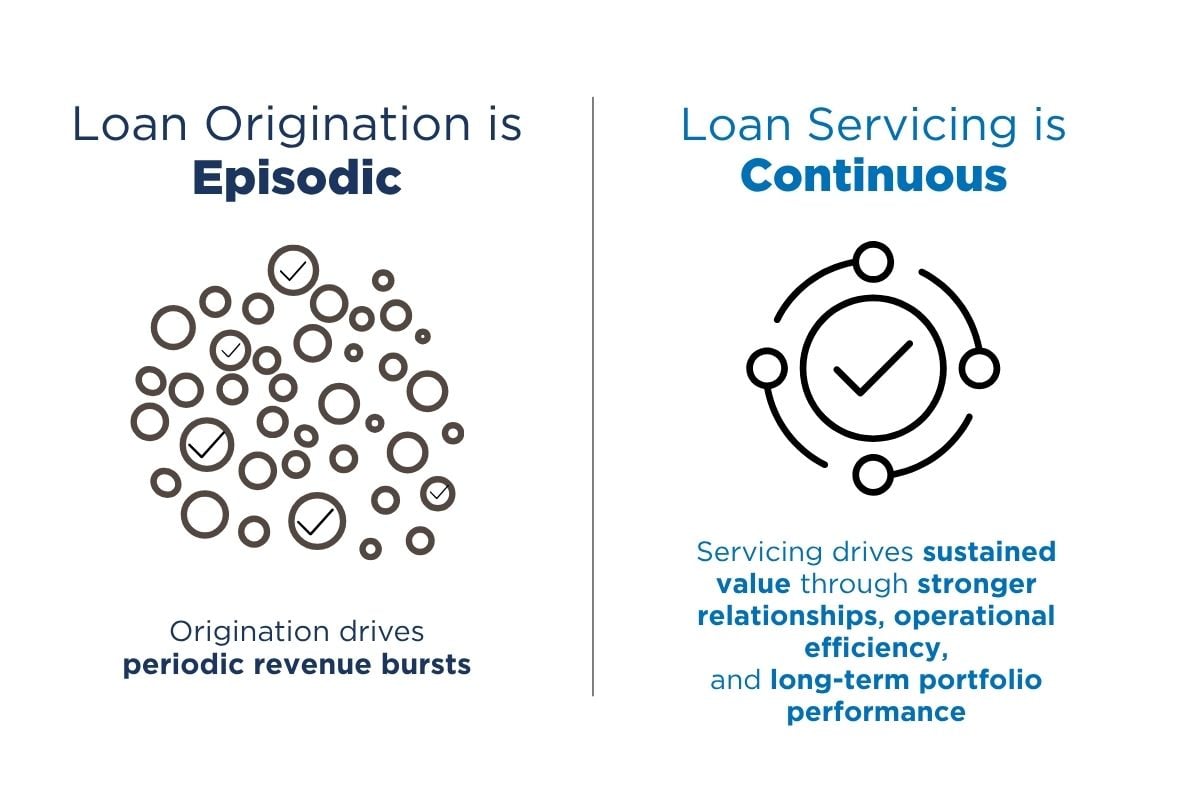
Loan origination is episodic.
Loan servicing is continuous.
One drives revenue in bursts. The other creates ongoing value through stronger relationships, operational efficiency, and long-term portfolio performance.
Between the two, continuous wins.
In 2026 and beyond, the real driver of auto lending growth is what happens after the loan is booked.
Origination is episodic. Servicing is continuous. Continuous wins.
What Happens After the Loan Is Funded?
And why is it such an important differentiator?
What differentiates institutions today is not simply how they book loans. It is how they manage the relationship after funding.
The moment of truth is no longer just day one.
It is every day after.
Throughout the life of an auto loan, operational pressure points can emerge, often unexpectedly. These may include repossessions, remarketing, impounds, title issues, total loss claims, GAP claims, product cancellations, vendor performance, recovery timing, and member communication.
The effect of asset management on the member relationship should not be overlooked.
Although every loan eventually reaches an end, the member experience spans the entire lifecycle. Every interaction shapes satisfaction, loyalty, and the likelihood that the member will return for another loan.
Risky Business: Can Credit Unions Maximize Member Relationships While Minimizing Loss?
Today’s borrowers behave differently than they did even a few years ago. They may be less loyal, refinance more often, switch lenders more easily, and continue shopping throughout the life of the loan. Relying on borrower loyalty alone is no longer a sustainable strategy.
The greatest long-term value is not created only at funding. It is built throughout the servicing relationship.
Servicing therefore influences the full cycle of member experience, recovery, refinancing, retention, and, ultimately, the next transaction.
In auto lending, this shift is even more important as used vehicles become a larger economic anchor.
Used inventory often turns faster.
Used-vehicle financing can be more resilient.
Used-vehicle borrowers may offer meaningful lifecycle value.
However, used-vehicle performance is heavily influenced by asset behavior, not just front-end pricing or credit scores. Many lenders may still be underestimating that distinction.
Credit risk will always matter, but asset behavior is becoming an important indicator of loss.
If you cannot effectively manage the asset, you cannot effectively manage the outcome.
That is why recovery velocity matters. The speed at which a problem is identified, the member is engaged, and action is taken on a deteriorating asset can significantly influence both loss severity and the member relationship.
Owning the Middle of the Member Relationship
Early signals may appear first in discretionary and asset-heavy markets, such as powersports, before stress becomes visible across broader auto portfolios.
This is where credit unions have an opportunity to differentiate.
Captive lenders may still own the front end of the sale, but credit unions have an opportunity to own the middle of the relationship. That includes servicing, communication, refinance triggers, member data, and lifecycle engagement.
That middle is becoming the most valuable part of the relationship.
Leading credit unions are building servicing ecosystems that connect protection products, recovery strategies, vendor management, GAP, total loss, and member communication through a unified lifecycle view.
Blind spots change as institutions shift strategies. Progress creates new angles that may not have been visible before. The question is not whether servicing blind spots exist, but whether an institution is equipped to recognize them before they become costly problems.
Conclusion
Loan growth has traditionally been measured at origination. Increasingly, competitive advantage will be measured by what happens after funding.
The institutions that outperform over the next decade will not simply originate more loans. They will manage the entire lifecycle more intentionally, from servicing and protection products to recovery and member engagement.
That is the role of effective asset risk management: transforming servicing from an operational function into a strategic advantage. Allied Solutions helps credit unions manage risks related to servicing, GAP, and recovery while identifying opportunities to strengthen portfolio performance.
The next decade of strong loan growth will not belong only to lenders that originate well. It will belong to those that manage the full lifecycle better.
Ready for a lifecycle servicing risk consultation? Contact John Elias for a personalized portfolio protection assessment.
